
Granite City Lookup Record Coverage
No single roll proves where one Granite City resident lives. Each record answers a narrower question. The Madison County tax roll identifies a parcel owner and a mailing destination, not an occupant. A court index identifies a party and case event, not a home. Vital records establish legal or family events within strict access rules. Business and license files describe an entity or professional credential. A sound resident lookup records the custodian, record date, and limits of each result.
| Record | What it can confirm | Official keeper | Access route |
|---|---|---|---|
| Property roll | Owner, situs, mailing address, PIN | Madison County | Devnet parcel search |
| Court index | Party role, case number, filing and docket | Circuit Clerk | County search landing page |
| Vital record | Birth, death, or marriage event | County Clerk or IDPH | Mail, counter, or eligible online order |
| Voter record | Registration information for a lawful political purpose | County Clerk | Madison County Voter Search |
| License or entity | Credential or filing status | IDFPR or Illinois SOS | Public individual search |
Start with the source that matches the fact at hand. An address points toward Devnet. A known court dispute points toward the Circuit Clerk. A family date belongs with the County Clerk, IDPH, IRAD, or the State Archives. When online access fails, Granite City researchers can call or visit the custodian, send a focused mail request, ask the library for historical help, or use Illinois FOIA for non-indexed agency records.
Normalize Granite City Resident Names
Preserve the spelling supplied by the researcher, then make a short variant list. Include middle initials, suffixes, maiden or married names, punctuation, and spacing. Illinois archive guidance shows why: McDonald may appear as Mc Donald or Mc@Donald, while apostrophes can alter an O’Hara search. Granite City’s immigrant history adds transliteration and compound-surname issues, especially in Lincoln Place and older Tri-Cities records.
Search broadly first. Then narrow by a dated Granite City address, a relative, a parcel, or a record type. Never merge two people just because a surname and city match. A useful confidence label is “confirmed by two independent dated records,” “probable but unresolved,” or “name-only lead.” That small discipline keeps the resident lookup from turning an index hit into a false identity claim.
Note: Original spellings can carry historical meaning, so record each variant and the source that printed it.
Check Granite City Court Parties
Granite City cases in the Illinois Third Judicial Circuit are kept by the Madison County Circuit Clerk. The county’s official page links to its court-search vendor and warns that the screen may load slowly at busy times. The research did not expose the vendor’s live field labels, so a responsible search should not assume filters that were not verified. Search the name and likely variants, preserve the exact case number, and check the party’s role and disposition.
The statewide re:SearchIL repository is a second electronic route, but access varies by user group, court, case type, and document. Restricted records are excluded. If the needed pleading is absent, call the Circuit Clerk at 618-692-6240 or use the courthouse counter at 155 N. Main Street, Suite 120, Edwardsville. Copy and certification charges must be confirmed with the clerk.
The county-linked court search is shown below. It is an index route, while the clerk remains the official custodian.

A result should be captured as a lead until the docket or filed document confirms what occurred.
Read Granite City Lookup Results
A case result becomes useful only when its fields are read in context. Capture the case number, public party names and roles, case type, filing date, court division, hearing events, disposition, document availability, and redaction status. Words such as dismissed, continued, vacated, sealed, and expunged do not mean the same thing. A docket is a dated list of case events; it may not include the pleading behind an event.
- Docket
- The court’s chronological list of filings, hearings, and orders.
- Index versus image
- An index summarizes a record. An image reproduces the filed page and may have separate access rules.
- Certified copy
- A copy authenticated by the official custodian for a formal need.
For a Granite City resident lookup, compare a public court detail with a second dated source. Do not publish a victim’s address, a minor’s information, a sealed matter, or an allegation as though it were a final finding.
Verify a Granite City Resident
Use a short evidence chain that distinguishes a person from others with the same name. The task is to confirm a limited fact, not to assemble a broad private profile.
- Search Devnet by owner name or site address. Save the PIN, situs, mailing destination, tax year, and owner name as separate fields.
- Check the Recorder’s grantor and grantee index when a legal property link matters. An owner mailing address still does not prove physical presence.
- Run the Circuit Clerk route for the name and its variants. Record party role, case number, date, type, and disposition.
- Use a vital index only for a relevant historic relationship or event, then order a copy from the proper custodian if eligible.
- Compare two independent sources and dates. Stop at “unresolved” when key details conflict.
Older Granite City placements can be checked against a dated city directory, Press-Record item, yearbook, cemetery source, or Census release. The Granite City city directories explain those historical collections without treating an old entry as current residence.
Granite City Vital Record Windows
The Madison County Clerk offers certified and genealogy routes, and the rules differ by record. County birth copies require the requester to qualify and supply ID. County guidance dates local marriages to 1813 and deaths to 1878. It treats genealogy copies as noncertified and stamps them “For Genealogical Purposes Only.” County thresholds are 75 years for births, 50 years for marriages, and 20 years for deaths.
Illinois law also has separate archive inspection periods under 410 ILCS 535/24: births at least 100 years old, deaths at least 50 years old, and marriages at least 75 years old, subject to archive rules. Do not blend those periods with the county’s genealogy-copy thresholds. Requests can go in person or by mail to the County Clerk at 157 N. Main Street, Suite 109, Edwardsville. State birth and death routes go through the Illinois Division of Vital Records, while IRAD and State Archives indexes help with older events.
Note: A vital index can support a relationship or date, but eligibility rules control access to the underlying copy.
Confirm Granite City Licenses
A professional or entity record can separate two same-name candidates without claiming where either person lives. The Illinois Secretary of State business search accepts business name, registered agent, officer or manager, file number, keyword, and partial-word searches. Its file detail can show formation, jurisdiction, registered office, status, and listed agents or officers. Those are filing relationships, not home-address findings.
The IDFPR License Lookup verifies a license by name or number and may show status, city and state, original date, expiration, and a discipline indicator. The captured official lookup appears below.
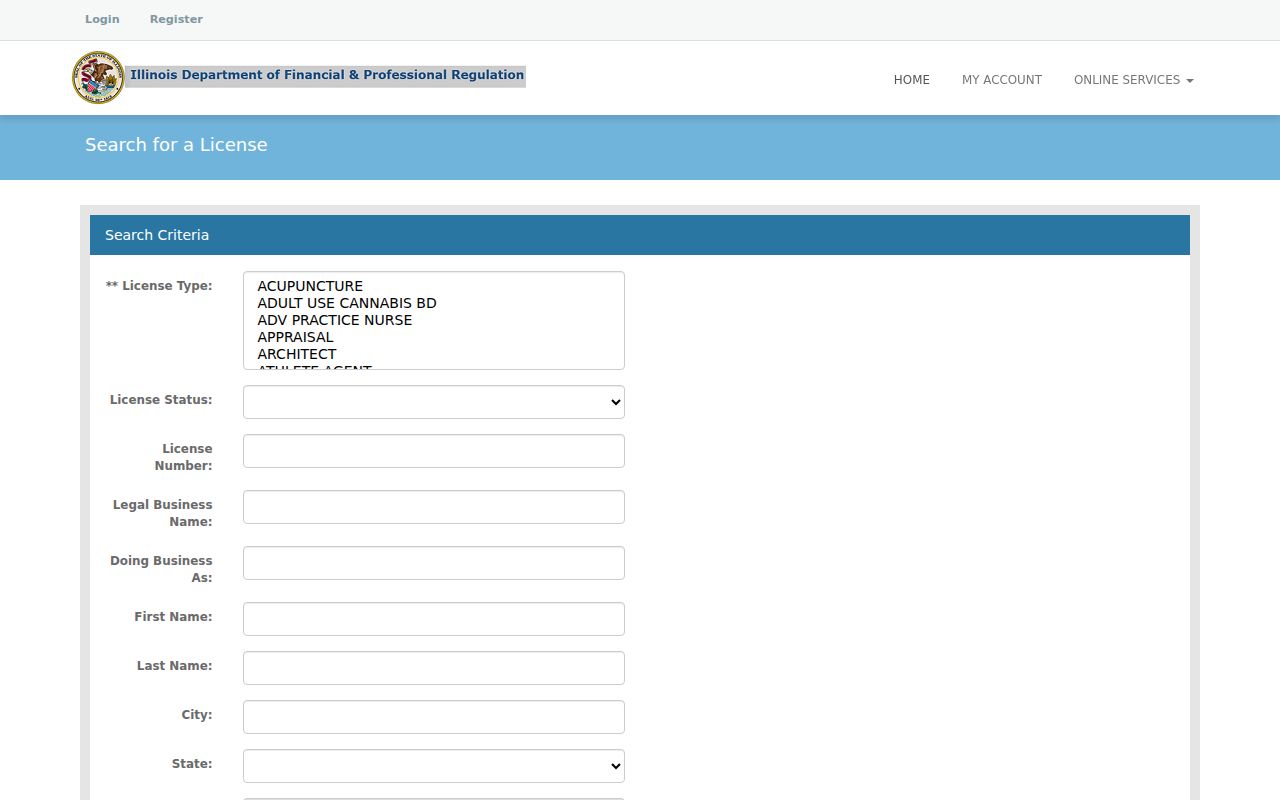
The city shown may be a practice location and may lag a move. Granite City business-license and permit questions can also go through BS&A Online, the City Clerk, or a focused Illinois FOIA request when no public register answers the question.
Granite City Voter Search Limits
Madison County’s voter tool carries a strict notice: information is for bona fide political purposes and not commercial solicitation or another business purpose, under 10 ILCS 5/4-8, 5-7, and 6-35. Its three dynamic input labels were not exposed in the research crawl, so no unverified field names should be claimed. Registration also is not proof of present residence.
The separate county election-history database publishes contests, candidates, questions, precinct totals, CSV data, and official PDFs. A 2025 Granite City City Clerk contest appears with precinct rows, but no individual voter names. That makes election history useful for civic geography, not for a general resident lookup. When a current voter question is lawful, use the county tool directly and retain only the minimum fact required.
Legal Limits for Granite City Lookups
The Illinois Attorney General’s Address Confidentiality Program provides eligible survivors a substitute address for many agency records. It is free and can support private voter registration, but it cannot guarantee secrecy in property records or remove old public copies. Never try to reverse-engineer a protected location by joining deeds, voter data, GIS, and court papers.
FOIA exemptions, court restrictions, and vital-record rules can withhold Social Security numbers, medical information, minor or victim data, sealed material, and protected addresses. Correct an error with the office that holds the record. Illinois FOIA is a route for non-indexed agency material, not a way around court or vital confidentiality.
Lawful use. Use a Granite City resident lookup for a focused, lawful personal purpose. Never use a public record to stalk, harass, threaten, or expose protected information.
Commercial people-finder results can be stale or attach a record to the wrong person. Treat the category only as an unverified lead, then return to official custodians. A restrained result, tied to a date and source, is safer and more accurate than a combined profile.