
Granite City Directory Shelves
Granite City's known holdings are spread across catalogs, physical shelves, microfilm, and digital collections. No official source supplies a complete first-to-last bibliography. The coverage table therefore distinguishes verified years from collections whose exact run still must be confirmed with staff.
| Collection | Verified years | Where held | Access |
|---|---|---|---|
| Polk's Tri-Cities directory | Annual designation 1931–; 1931 and 1972 displayed | FamilySearch catalog | Catalog; some images may need login or center |
| Combined regional phone books | 1941, 1969, 1974, 1978 | St. Louis County Library | Library holdings; ask the desk |
| Granite City phone book | 1968 | St. Louis County Library | Library shelf |
| Granite City city directories | 1998–2002 | St. Louis County Library, R 917.7386 G759 | Library shelf |
| Tri-Cities local collection | Exact directory years not listed | Six Mile Regional Library District | Delmar/Johnson locations and research staff |
| Press-Record | April 22, 1903 to December 26, 2012 publication span | SMRLD | Free digital archive and microfilm; gaps possible |
The St. Louis County Library page shown below is the verified year guide. Check its Illinois city-directory holdings before traveling.
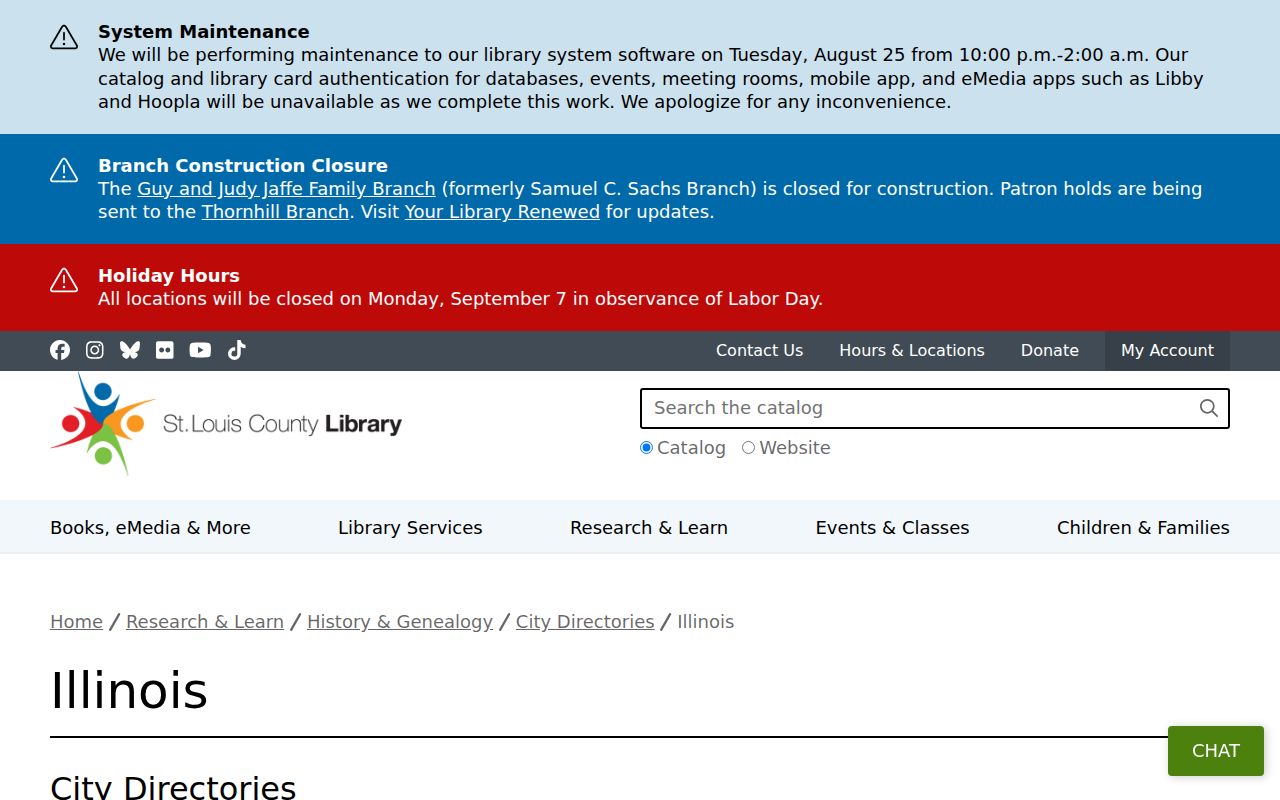
The capture confirms shelves, not a continuous run. A missing listed year might mean no edition, a catalog gap, or a volume held elsewhere.
Granite City Tri-Cities Directory
FamilySearch catalogs “Polk's tri-cities (Madison County, Illinois) city directory: including Granite City, Madison, Mitchell, Venice, Nameoki.” R.L. Polk & Co. is the author, Polk the publisher, and the catalog carries an annual designation beginning in 1931. The displayed items include 1931 and 1972. Do not expand those two visible years into a claim that every annual volume survives.
The catalog image below provides the title, publisher, places, annual designation, and access state.
Search the FamilySearch catalog by place, surname, title, author, subject, or keyword. Try Granite City, Madison County, Tri-Cities, Nameoki, Madison, Mitchell, and Venice. Inspect each format note because a digitized image can require an account or a FamilySearch Center. The Granite City library locations at 2001 Delmar and 2145 Johnson are listed as affiliates, so staff can explain local access.
Read a Granite City Entry
A city directory entry is a dated transcription. Copy what is printed, including punctuation and abbreviations. Do not silently turn a boarder into an owner or assume a business address was a home. The exact legend varies by edition, so photograph or transcribe the abbreviation key before interpreting marks.
| Name | Printed surname and given name or initials, including spelling variants |
|---|---|
| Household marker | Spouse, widow, boarder, student, or other role only if printed |
| Occupation | Work or employer wording as that edition records it |
| Address | House number, street, and any residence or business marker |
| Telephone | Number when the edition includes one |
| Edition evidence | Year, page, title, publisher, and repository |
The research did not capture a visible Granite City sample page, so no local owner or renter symbol should be invented. Record the key from the volume in hand.
- Criss-cross directory
- A section arranged by street or phone number instead of surname.
- Householder index
- An address-oriented list of the person the publisher treated as the main household entry.
- Abbreviation key
- The publisher's legend for roles, street terms, occupations, and symbols.
- Compilation lag
- The delay between gathering an entry and publishing the book.
Granite City Library History Room
Six Mile Regional Library District's local-history service covers Granite City, Mitchell, and Pontoon Beach. It identifies historical city directories, the Press-Record, yearbooks, cemetery material, “Six Miles of Local History,” and research help. Contact research@smrld.org or 618-452-6238 ext. 730; the main research location is 2001 Delmar Avenue.
The 2025 materials policy says the special collection documents civic, social, religious, cultural, political, and economic life across Granite City and the Tri-Cities. It includes print, microform, electronic material, directories, school yearbooks, newspapers, primary sources, local books, and industrial artifacts. The policy also says the collection is not a legal repository and lacks climate-controlled archival storage.
Ask staff to verify city directory years and search for reverse, criss-cross, house, and telephone directories. The library pages did not publish a complete reverse run or shelf numbers. Staff assistance and physical inspection are the proper fallback.
Granite City Press-Record Bridge
The Granite City Press began April 22, 1903, later became the Press-Record, and ended with the December 26, 2012 issue. It covered Granite City and nearby Tri-Cities communities. After permission work in 2012, practical scanning began in 2019. More than 369 microfilm reels were converted for free public use, though the current archive must be checked for year and issue gaps.
A city directory may provide a name and street. The Press-Record can add a marriage notice, obituary, church event, school activity, business notice, or address change. Search spelling variants and OCR errors, then cite the newspaper date and page rather than treating a search snippet as the record.
The library's digital host was not successfully captured in the manifest, so no image is used here. The live local-history route and staff remain valid access channels.
Note: A newspaper notice adds dated context, but it does not replace a deed, directory page, or certified vital record.
Granite City Yearbook Companions
School sources can fill a city directory gap, especially for young people who were not the main alphabetical entry. The SMRLD yearbook list includes Granite City High School volumes for 1910, 1911, 1913–1920, 1925, 1927–1930, and 1955–2010, with many later years. Granite City High School North is listed for 1974–1983. Physical volumes are noted at the Delmar site, with 1962–2018 material also at Johnson.
The successful capture below shows the local yearbook collection and its stated gaps.
Missing or difficult years listed by the library include 1912, 1921–1924, 1926, and 2010. Madison Historical also digitized eighteen Granite High World school newspapers from 1935–36 through 1955–56. A portrait, club list, or school story can support identity and date, but not an adult address unless the source prints one.
Granite City Historical Cross-Checks
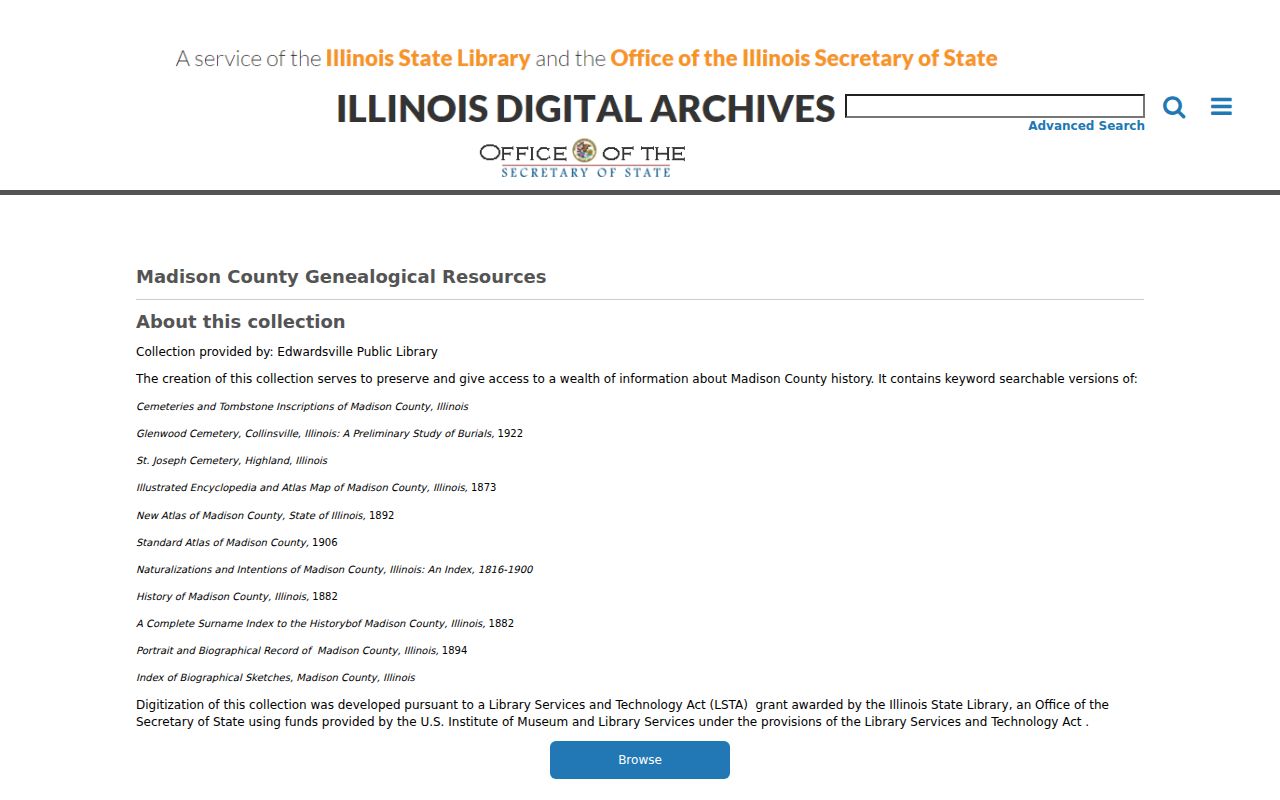
When directories break, move sideways. Illinois Digital Archives holds Madison County atlases from 1873, 1892, and 1906, a naturalizations and intentions index for 1816–1900, county histories, and cemetery material. Its Granite City cemetery volume covers Odd Fellow, New Methodist, and St. Mark's cemeteries. Cemetery data is a burial lead, not current address evidence.
The successful Illinois Digital Archives image below shows the regional genealogy collection.
IRAD adds deed indexes for 1814–1910, deeds for 1814–1879, marriages from 1813, death series from 1878, probate files, and other local-government records. Access runs through its online finding tools and the IRAD reference route at Morris Library, SIU Carbondale. Those sources predate the city directory era and often use legal descriptions, township labels, or variant spellings.
Granite City Names in Lincoln Place
Lincoln Place, west of downtown near the Chain of Rocks Canal, was known as Hungary Hollow before residents adopted the Lincoln Place name in 1916. Madison Historical records Hungarian immigration in the early twentieth century, followed by Bulgarian, Macedonian, Italian, Mexican, and Armenian communities linked to Granite City industry. Search both neighborhood names and nearby street terms.
Madison Historical's encyclopedia and archive preserves articles, oral histories, newspapers, school material, and scanned local records.

Industry terms can unlock entries and news: National Enameling & Stamping Company, Granite Ironware, Royal Granite Steel Ware, Royal Granite Enameled Ware, and Nescoware. Preserve transliteration, maiden names, compound surnames, and spacing variants. Never assign an ethnicity or personal role from a surname or factory name alone.
Granite City Directory Timeline
The surviving record landscape grows in layers. A short timeline helps place each city directory beside the sources that can test it.
| Date | Granite City research milestone |
|---|---|
| 1812 | Madison County established; Recorder land records begin |
| 1903 | Granite City Press begins publication |
| 1931 | Displayed Polk Tri-Cities directory and annual catalog designation |
| 1941–1978 | Verified combined regional books and 1968 phone book |
| 1998–2002 | Verified St. Louis County Library city directory run |
| 2012–2019 | Press-Record digitization permission and scanning project stages |
The timeline is not a claim of continuous directory publication. The complete bibliography and last printed local edition remain research gaps.
Trace Granite City Family History
Follow a household across time without treating any one edition as final. Pair the printed name with the exact address, then test that relationship in sources made for a different purpose. Census schedules become public under the 72-year rule and can fill decade points, while the city directory can fill years between them.
- Find the earliest verified edition that contains the surname or address, and copy the entry exactly.
- Move one edition forward and backward; note spelling, spouse markers, occupations, phones, and every address change.
- Use a verified criss-cross or street section to see who the publisher listed at the address, without assuming ownership.
- Compare Census years and Press-Record dates, keeping historical Nameoki township and city-boundary differences in mind.
- Close the trail with deeds, vital indexes, cemetery records, obituaries, naturalization files, or probate as the question requires.
Disappearance can mean a move, death, omission, name change, unlisted telephone, or missing volume. Check the next source instead of choosing one explanation. For modern parcel and permit evidence, use the Granite City by-street records.